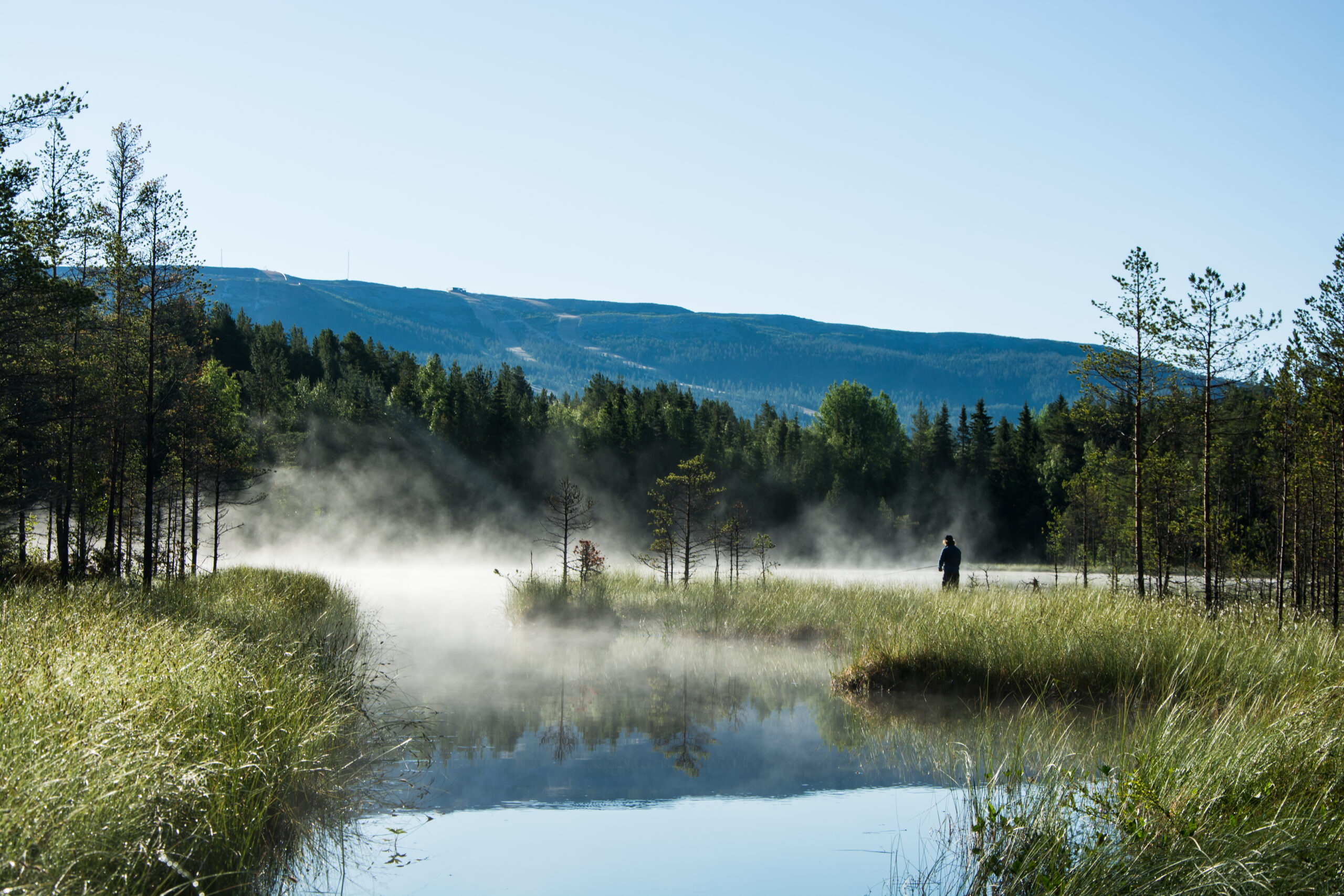
Vemdalens ”fiskevirtuos” Gunnar Ekberg delar med sig av sina bästa tips om destinationens vanligaste arter – och var du har störst chans att få napp, oavsett om du är nybörjare eller erfaren fiskare. Ta del av guiden för fiske nedan.
Grayling
The delicate grayling is fished throughout the summer. It thrives best in flowing, oxygen-rich waters and can be found from the mountains down into the forested lowlands. The grayling is a popular target for novice fly-fishing enthusiasts. It isn’t particularly shy, feeds on surface prey, and often rises to the surface. It is often found in calm pools or where a current flows into or out of a larger pool. It is also not particularly picky about what it eats, and since you can get close to it, perfect precision casts are not required. Fishing with a spinning rod and a worm can yield excellent results. The best time for grayling fishing is around Midsummer—but September is also a good month for those who want to enjoy grayling stew in the Vemdalsvis style. Grayling is protected in the area from April 1 to May 30.
Ekberg's Tips
“Veman is the best spot for grayling, hands down. The Ljungan River in the Börtna area isn’t bad either. The Ljusnan River near Hedeviken is also a great spot for grayling.”
Läs mer om Harrfiske i destination Vemdalen här
Whitefish
The whitefish thrives best in lakes but also hunts in the calmer sections of flowing water—what we call eddies or pools. It can be found all the way up to the border between forest and mountain. The whitefish is a frequent surface feeder, and the ripples on the water give it away. It is toward those ripples that the fly or spinner should be cast. The whitefish is a good “beginner’s fish” because it is not as easily spooked as, for example, the char. And since it is both an insectivore and a predator, it can be caught with flies, spinners, and worms alike.
Ekberg's Tips
“Try Klövsjön and Lännässjön nearby. Vikarsjön usually yields good catches as well.”
Char
This beauty is probably every mountain angler’s dream catch. It can be found in virtually every mountain lake and in some forest lakes—but it’s shy and hard to entice. And during the summer, it’s even more elusive than usual. The best time is around Midsummer, when the char’s favorite mayfly, the “rock,” hatches. That’s when it feeds actively.
Fly fishermen should use small flies, but conventional angling and spin fishing also work well. If you have access to a boat, trolling and ice fishing are definitely worth trying.
Ekberg's Tips
“Oxsjön is a mountain lake with some really big char. The hike there is seven kilometers long—but well worth the effort. A visit to Storvåndtjärn in Vemhån is a must for a great fishing experience. There are plenty of great char lakes around Hedeviken. One of them is Tumsjön.”
Perch
A rod, line, float, hook, and a jar of worms—that’s all you need for successful perch fishing. Especially during the first half of the summer, worms are superior to everything else. In late summer, it’s well worth trying to use roach or other small fish as bait. And the fact is, even fly fishing works.
Perch are most abundant in the lakes and streams of forested areas. They are easiest to find in the mornings and evenings, in shallow water near reed beds and rocks.
Ekberg's Tips
“Lake Klövsjön has been my favorite since I was a child. Lake Vikarsjön is another one.”
Brown trout
This species thrives in fresh, clean water—and we have plenty of that here. That’s why trout are our most common fish—in flowing streams, rivers, and creeks, as well as in ponds and lakes. You have to sneak up on the shy trout, using bushes and trees for cover. It has keen eyesight and can sense even the slightest vibrations. Trout fishing in the Ljusnan begins as early as the end of March or beginning of April, and it remains legal until September 1. Trout will strike at just about anything. Fly fishing is the most common method, but spinning and bait fishing also work. Spinning with a wobbler can yield some real whoppers. In lakes and flowing waters, keep an eye out for rocks, calm sections of streams, riffles, and backwaters. That’s where you’ll find them.
Ekberg's Tips
“Storvåndtjärn in Vemhån is a great spot. So is Lännässjön. You should also check out Vikarsjön and Stavsjön near Hedeviken.”
Pike
This voracious predator is most commonly found in the lakes and streams of forested areas. Here, fall is the best time for pike fishing. Cast your line where the bottom has gravel, rocks, and cavities. That’s where the pike’s prey can be found—and the hungry predator is never far behind. Spring can also yield some solid strikes. That’s spawning season, and the males are often found in shallow coves, where they wait for the females. During midsummer, they stay in the depths of cooler waters and can be reached in the evenings and at night when they move into shallower waters.
Ekberg's Tips
“In Vemhån, there are two excellent pike lakes: Håsjön and Yttersjön. Another sure bet is Vikarsjön near Hedeviken.”
På plats i Vemdalen?
Gör ett besök hos Ekbergs Fiske & Fritid och få tips direkt från de som vet bäst!